
In the aftermath of the collapse of the the Moche civilisation in the late 700s A.D. a new civilisation was born. In the late 800s until the early 1000s the Chimú culture began to establish itself, reaching it’s peak in the 1200s and lasting until the 1490s when they were conquered by the Incas.
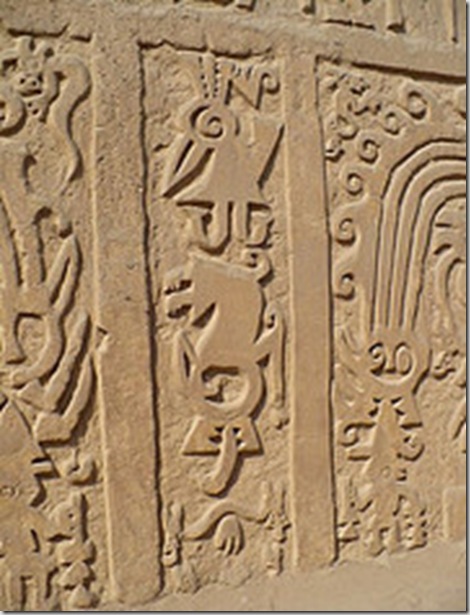
The Chimú set up an empire that stretched from Peru’s border with Ecuador to the region of Lima. In the centre of this 1000km stretch of coast the Chimú built their capital city Chan Chan, which is a corruption of the Mochic words Sian-Sian or Sun Sun. At roughly 18km2 it is the biggest adobe city in the world, and was at the time one of the largest cities in the world.
 Chimú-Lambayeque pot
Like the Moche, the Chimú too built stepped pyramids. These hosted temples on their truncated peaks with a large ramp leading up. These constructions were somewhat more simple than those of the Moche and did not contain anything inside – they were solid formations of hundreds of thousands of mud bricks.
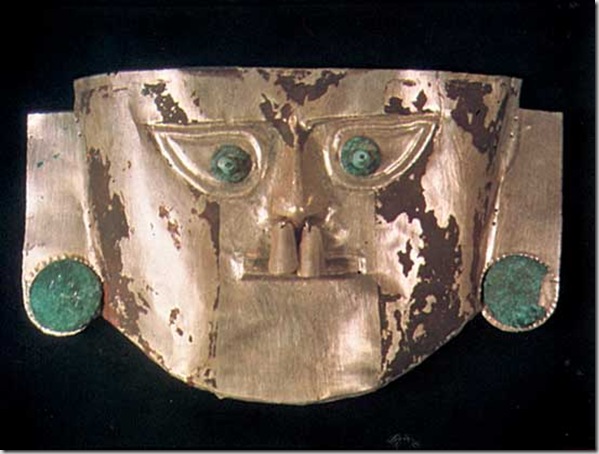 A death mask from the Chimú culture is made of a gold and silver alloy, with copper eyes and ears
Another thing that differentiates the Chimú from their Moche ancestors is their affinity with the sea. This may be due to one of the myths of the origin of their civilisation or simply due to the fact that they relied heavily on a sea food diet, fishing using their caballitos de totora. Whatever their reason, their constructions and monochrome pottery are covered with decorations showing fish, waves, sea birds and fishing nets. Most of their capital city, Chan Chan is less than a few hundred metres from the ocean and can be heard throughout the city.
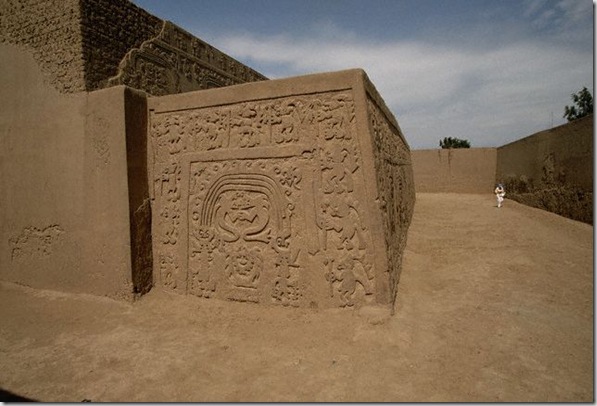 Walls of the City of Chan Chan
After the Chincha culture, the Chimú were the next and final strong nation state the Incas had to conquer to form their massive empire. Also an agricultural-based civilisation, this was the major Chimú weakness when the Incas attacked. On entering the Chimor empire and approaching the city of Chan Chan, the Incas made sure to destroy all the irrigation systems that gave life to the sun-baked arid area. The Inca attack began in 1470 and lasted until 1493 with the defeat of the Chimú, who made sure to heavily destroy their capital city and loot its gold before the Incas did. Fonte
The Kingdom of Chimor emerged from the desert sands of coastal Peru between AD 900 and AD 1430. The kingdom is characterised by the hierarchical power structures of royal palaces and capital cities not found in many of the other complex societies in South America.
Power and control in the region was managed from the capital city of Chan Chan including some of the huge civil engineering projects undertaken to irrigate and transform this desert into an empire spanning 600 miles down the coastline of modern day Peru.
 Chimu stirrup spout vessel, Chimu, AD 900-1430
Figures and faces
Black Chimu ceramics are some of the most distinctive elements of their material culture. The frequent portrayal of figures and faces bring to life the people who made and used the pots.
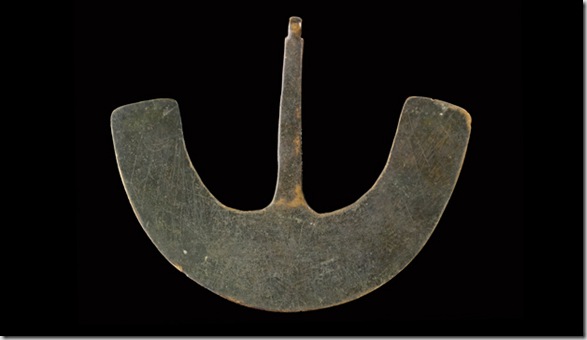 Copper Knife, Cusco, unknown date
Mass production
This distinctive style of knife design is found at many sites in South America and it was used in both practical and ritual settings. Large numbers of metal artefacts like this are found at Chimu sites like Chan Chan, the capital of the Chimu empire. These artefact collections demonstrate how this empire transformed the scale of production during this late pre-Columbian period in South America.
 Llama vessel, Chimu, AD 900-1430
Trade and tribute
The Chimu empire was built upon a network of trade and tribute that funnelled its way back to the capital of Chan Chan from all of the surrounding provinces. The depiction of the llama in the pottery of these coastal peoples hints at how far these territories spread, up the coastal river valleys and into the Andean mountains.
 Silver vessel, Chimu, AD 900-1430
Displaying wealth
Excavations of Royal Tombs in coastal Peru have recovered exquisite gold and silver artefacts. Objects like this silver Chimu vessel demonstrate how wealth was centralized to a powerful elite that controlled and ruled the empire with a rigid hierarchy.
 Spondylus shell, Moche, AD 100-800
A prized possession
The spondylus shell was one of the most highly valued materials in Chimu society. These marine shells normally only live in the warmer waters further north up near the present day coast of Ecuador. There are many theories, often relating to climate change, that are used to explain why they became so prized within Chimu society.
Fonte
>>>

The Chimú set up an empire that stretched from Peru’s border with Ecuador to the region of Lima. In the centre of this 1000km stretch of coast the Chimú built their capital city Chan Chan, which is a corruption of the Mochic words Sian-Sian or Sun Sun. At roughly 18km2 it is the biggest adobe city in the world, and was at the time one of the largest cities in the world.
 Chimú-Lambayeque pot
  A death mask from the Chimú culture is made of a gold and silver alloy, with copper eyes and ears
 Walls of the City of Chan Chan
The Kingdom of Chimor emerged from the desert sands of coastal Peru between AD 900 and AD 1430. The kingdom is characterised by the hierarchical power structures of royal palaces and capital cities not found in many of the other complex societies in South America.
Power and control in the region was managed from the capital city of Chan Chan including some of the huge civil engineering projects undertaken to irrigate and transform this desert into an empire spanning 600 miles down the coastline of modern day Peru.
Chimu stirrup spout vessel, Chimu, AD 900-1430 Black Chimu ceramics are some of the most distinctive elements of their material culture. The frequent portrayal of figures and faces bring to life the people who made and used the pots.
 Copper Knife, Cusco, unknown date
 This distinctive style of knife design is found at many sites in South America and it was used in both practical and ritual settings. Large numbers of metal artefacts like this are found at Chimu sites like Chan Chan, the capital of the Chimu empire. These artefact collections demonstrate how this empire transformed the scale of production during this late pre-Columbian period in South America.
 Llama vessel, Chimu, AD 900-1430
 The Chimu empire was built upon a network of trade and tribute that funnelled its way back to the capital of Chan Chan from all of the surrounding provinces. The depiction of the llama in the pottery of these coastal peoples hints at how far these territories spread, up the coastal river valleys and into the Andean mountains.
 Silver vessel, Chimu, AD 900-1430
 Excavations of Royal Tombs in coastal Peru have recovered exquisite gold and silver artefacts. Objects like this silver Chimu vessel demonstrate how wealth was centralized to a powerful elite that controlled and ruled the empire with a rigid hierarchy.
 Spondylus shell, Moche, AD 100-800
 A prized possession
The spondylus shell was one of the most highly valued materials in Chimu society. These marine shells normally only live in the warmer waters further north up near the present day coast of Ecuador. There are many theories, often relating to climate change, that are used to explain why they became so prized within Chimu society.
Fonte


![clip_image001[1]](https://blogger.googleusercontent.com/img/b/R29vZ2xl/AVvXsEjn2h6I0xvGiT_xgwVgI-ScvrixYZ7aeO8gaCOBRbI2iJ9oPxUpSQBtuVBaPnIhd21s3IjA1ADfMskUYiMKx2nJZNdQosVlAQA29833POsvsLE0EqTU-SqSVFK1H1ccmUdcOr5UIcWjLEa0/s1600-h/clip_image001%25255B1%25255D%25255B5%25255D.jpg "clip_image001[1]")
![clip_image003[1]](http://lh3.ggpht.com/-i9IGcpSU3O0/Tjh5-fihtEI/AAAAAAAA0VE/N7_5NcrQZ1E/s1600-h/clip_image003%25255B1%25255D%25255B5%25255D.jpg "clip_image003[1]")


 Photo credit


