
Henri de
Toulouse-Lautrec (24 November 1864 - 9
September 1901) was a French painter, printmaker, draftsman, and illustrator,
whose immersion in the decadent and theatrical life of fin de siecle Paris
yielded an oeuvre of provocative images of modern life.
Hi was born in Albi, Tarn in the
Midi-Pyrenees region of France, the firstborn child of Comte Alphonse and
Comtesse Adele de Toulouse-Lautrec. An aristocratic family (descendants of the
Counts of Toulouse) that had recently fallen on hard times, the
Toulouse-Lautrecs were feeling the effects of the inbreeding of past
generations; the Comte and Comtesse themselves were first cousins, and Henri
suffered from a number of congenital health conditions attributed to this
tradition of inbreeding (see below). A younger brother was born to the family
on 28 August 1867, but died the following year.
Disability
At the age of 13 Henri fractured his left thigh bone, and at 14, the right.
The breaks did not heal properly. Modern physicians attribute this to an
unknown genetic disorder, possibly pycnodysostosis (also sometimes known as
Toulouse-Lautrec Syndrome), or a variant disorder along the lines of
osteopetrosis, achondroplasia, or osteogenesis imperfecta. Rickets aggravated
with praecox virilism has also been suggested. His legs ceased to grow, so that
as an adult he was only 1.54 m (5 ft 1 in) tall, having developed an
adult-sized torso, while retaining his child-sized legs, which were 0.70 m
(27.5 in) long. He is also reported to have had hypertrophied genitals.
Physically unable to participate in most of the activities typically
enjoyed by men of his age, Toulouse-Lautrec immersed himself in his art. He
became an important Post-Impressionist painter, art nouveau illustrator, and
lithographer; and recorded in his works many details of the late-19th-century
bohemian lifestyle in Paris. Toulouse-Lautrec also contributed a number of
illustrations to the magazine Le Rire during the mid-1890s.
Paris
Toulouse-Lautrec was drawn to Montmartre, an area of Paris famous for its
bohemian lifestyle and for being the haunt of artists, writers, and
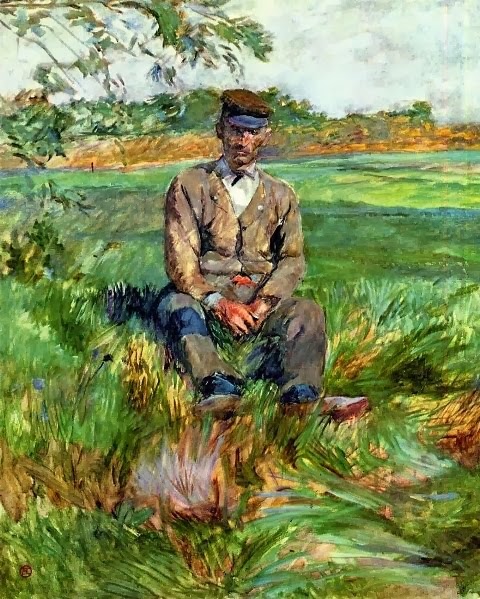
philosophers. Tucked deep into Montmartre was the garden of Monsieur Pere Foret
where Toulouse-Lautrec executed a series of pleasant plein-air paintings of
Carmen Gaudin, the same red-head model who appears in The Laundress (1888).
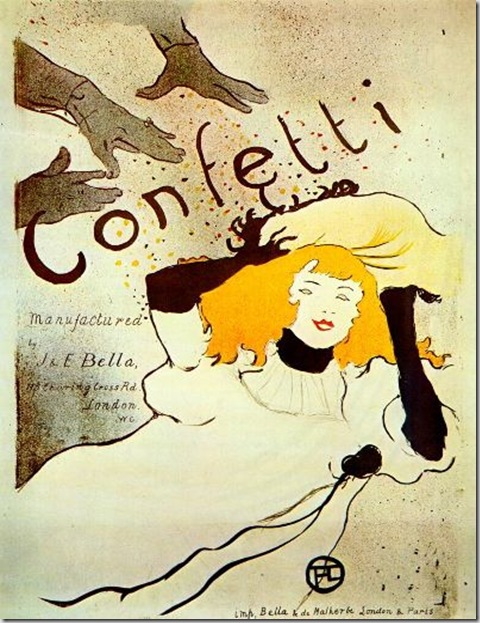
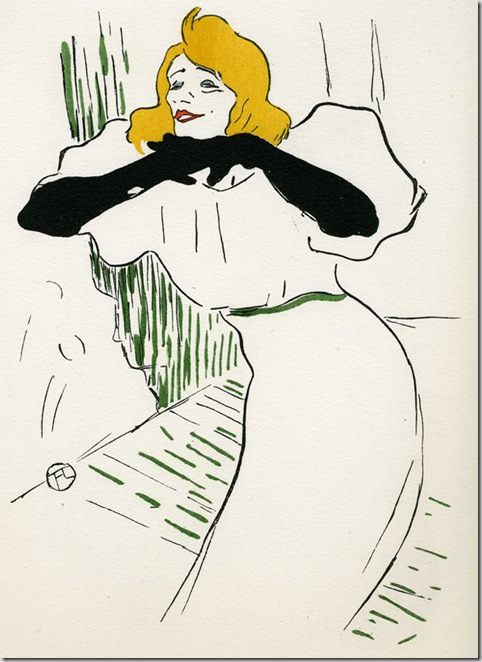
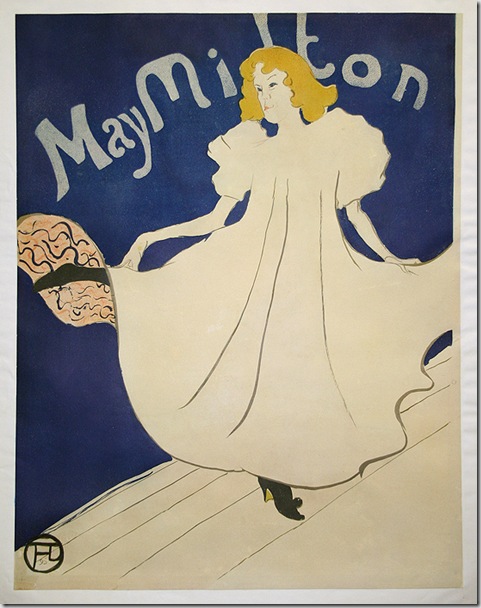
When the nearby Moulin Rouge cabaret opened its doors, Toulouse-Lautrec was
commissioned to produce a series of posters. Thereafter, the cabaret reserved a
seat for him, and displayed his paintings. Among the well-known works that he
painted for the Moulin Rouge and other Parisian nightclubs are depictions of
the singer Yvette Guilbert; the dancer Louise Weber, known as the outrageous La
Goulue ("The Glutton"), who created the "French Can-Can";
and the much more subtle dancer Jane Avril.
Toulouse-Lautrec spent much time in brothels, where he was accepted by the
prostitutes and madams to such an extent that he often moved in, and lived in a
brothel for weeks at a time. He shared the lives of the women who made him
their confidant, painting and drawing them at work and at leisure. Lautrec
recorded their intimate relationships, which were often lesbian. A favourite
model was a red-haired prostitute called Rosa la Rouge from whom he allegedly
contracted syphilis.
Toulouse-Lautrec gave painting lessons to Suzanne Valadon, one of his
models (and possibly his mistress as well).
An alcoholic for most of his adult life, Toulouse-Lautrec was placed in a sanatorium
shortly before his death. He died from complications due to alcoholism and
syphilis at the family estate in Malrome, fewer than three months before his
37th birthday. He is buried in Verdelais, Gironde, a few kilometers from the
Chateau of Malrome, where he died.
Toulouse-Lautrec's last words reportedly were: "Le vieux con!" ("Old
fool!")
Tremblement de Terre
The invention of the Tremblement de Terre is attributed to
Toulouse-Lautrec, a potent mixture containing half absinthe and half cognac.
Legacy
Throughout his career, which spanned less than 20 years, Toulouse-Lautrec
created 737 canvases, 275 watercolors, 363 prints and posters, 5,084 drawings,
some ceramic and stained glass work, and an unknown number of lost works.
Toulouse-Lautrec is known along with Cezanne, Van Gogh, and Gaugin as one of
the greatest painters of the Post-Impressionist period. His debt to the
Impressionists, in particular the more figurative painters Manet and Degas, is
apparent. In the works of Toulouse-Lautrec can be seen many parallels to
Manet's bored barmaid at A Bar at the Folies-Bergere and the behind-the-scenes
ballet dancers of Degas. He excelled at capturing people in their working
environment, with the colour and the movement of the gaudy night-life present,
but the glamour stripped away. He was masterly at capturing crowd scenes in
which the figures are highly individualised. At the time that they were
painted, the individual figures in his larger paintings could be identified by
silhouette alone, and the names of many of these characters have been recorded.
His treatment of his subject matter, whether as portraits, scenes of Parisian
night-life, or intimate studies, has been described as both sympathetic and
dispassionate.
Toulous-Lautrec's skilled depiction of people relied on his painterly style
which is highly linear and gives great emphasis to contour. He often applied
the paint in long, thin brushstrokes which often leave much of the board on
which they are painted showing through. Many of his works may best be described
as drawings in coloured paint.
After Toulouse-Lautrec's death, his mother, the Comtesse Adele
Toulouse-Lautrec, and Maurice Joyant, his art dealer, promoted his art. His
mother contributed funds for a museum to be built in Albi, his birthplace, to
house his works. As of 2005, his paintings had sold for as much as US$14.5
million. (From Wikipedia)




,+1891.jpg)




![clip_image002[6]](https://blogger.googleusercontent.com/img/b/R29vZ2xl/AVvXsEjPA9G_pFB6rM8g3rtjoLYJHoG9Y2xrfx1N9vLUFu0eZPxcD0CKrTHvhycvypt_aGvY_FvNF_bh74H6laCoJI8ne-rVljikjldiGRKQKzUfRPn003sGMNz3dCus382MtxYO1q-JH_ZgCFiG/s1600-h/clip_image002%25255B6%25255D%25255B6%25255D.jpg "clip_image002[6]")
![clip_image004[4]](https://blogger.googleusercontent.com/img/b/R29vZ2xl/AVvXsEg0WyiUA7A6rFvpXCWFaPzkXpGMf7e1tlKAnTp5uO-KpnPwCbwdKV8wnhsEXLmWtuaM7ko13O3be4rEG09Isc3TjimxuvL7UG52v0MFEKKOig73ImbNvfqVDGTM8-XL8zPxddOLWxSBzT1i/s1600-h/clip_image004%25255B4%25255D%25255B5%25255D.jpg "clip_image004[4]")
![clip_image002[4]](https://blogger.googleusercontent.com/img/b/R29vZ2xl/AVvXsEgxcvVG1hjRgvyUzZMyPPm0HSJs9USPgZShnYy5DEiQyJJ5okTLyCqcFIT7-B1N5P95qR42dFETGL2JmvcJu3vaE2mBHfNDo_p9qNGVlg0gX2la7XFhX4PhVr9cblXhhHz1B0gC3QVdLdl_/s1600-h/clip_image002%25255B4%25255D%25255B6%25255D.jpg "clip_image002[4]")

