Visualizzazione post con etichetta india. Mostra tutti i post

venerdì 2 giugno 2017

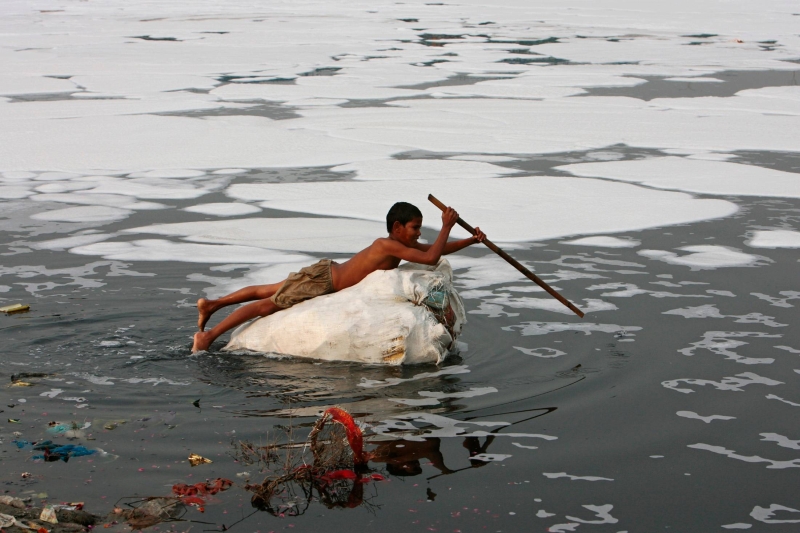
UGLY REALITY OF YAMUNA – INDIA’S MOST POLLUTED RIVER


Hindus believe that one dip in the sacred River Yamuna frees one from the torments of death.  But burden of overgrowing population and unchecked dumping of sewage and industrial waste has rather turned it into a horrible scene.  Now, River Yamuna is seeking salvation from tormenting pollution. The Yamuna, also called Jammuna, is the second largest tributary river of the Ganges that flows through Indo-Gangetic Plains. It originates from the Yamunotri Glacier in Himalayas and flows through Uttarakhand, Haryana, Delhi and Uttar Pradesh. The water is clear and blue until the River reaches Haryana. Thereafter, tons of untreated sewage, industrial waste, domestic waste, and dumped garbage turn it into one of the world’s most polluted rivers. Urbanization and industrialization has literally killed River Yamuna. New Delhi, that generates 1,900 million liters per day of sewage, dumps 58 percent of its waste into Yamuna. Untreated waste that flows into it from several cities along its banks in Haryana and Uttar Pradesh is Yamuna’s biggest enemies.
In Uttar Pradesh, the river is almost invisible, covered with pollutants and foam. The government has spent Rs 1,514.70 crore under Yamuna Action Plan Phase-I and Phase-II for creation of new sewage treatment capacity of 942.25 million liters per day in Delhi, Haryana and Uttar Pradesh. However, the scenario doesn’t seem to have changed in 2015.
According to a 2015 report,
“The Yamuna, by the time it flows through Agra, has nearly 50 times more biochemical oxygen demand (BOD) than the permissible limit. The Central Water Commission (CWC) has declared that the river water at Agra is safe neither for irrigation nor for domestic use. Water in the river, now polluted beyond repair, an official said, is also contaminating ground water.”
According to the Central Water Commission (CWC),
“The current level of BOD in Yamuna is 55 milligram per litre (mg/L), which is enormously high as compared to the permissible limit of 2 mg/L. This contamination level is irreversible. Water is unusable, both for irrigation and drinking. In fact, polluted water from the Yamuna is also partially responsible for the contamination of ground water in Agra, as the TDS (total dissolved salt) in water has jumped to almost 1500 mg/L from 500 mg/L, three times the permissible limit.”
According to health experts,
“Even the vegetables coming from neighbouring towns like Ghaziabad and Faridabad – where farmers rely on polluted rivers for irrigation add to the water pollution related complications for Delhiites. The drinking water that most Delhites get had been found to be contaminated with sewage water and could be harmful to health. A shocking 81 out of 116 samples of such water – it translates to almost 70 per cent – supplied across the Capital by the DJB have failed a purity test conducted by the Municipal Corporation of Delhi in 2012.”
River Yamuna is now considered beyond redemption from pollution. The contamination has reached such a high level that it’s almost impossible to clean it. It’ll be a miracle if Yamuna could be revived. Take a look at some of the pictures depicting death of India’s most polluted river – Yamuna. Remember, almost every river in India is heading toward the same future as India is still not serious regarding prevention of dumping pollutants into its rivers.
Image Credits : Daily Mail/ Hindustan Times/Sand DRP  planetcustodian


 Image Credits : Daily Mail/ Hindustan Times/Sand DRP
>>>

sabato 10 maggio 2014

INDIAN CIRCUS | MARY ELLEN MARK

MARY ELLEN MARK has achieved worldwide visibility through her numerous books, exhibitions and editorial magazine work. She has published photo-essays and portraits in such publications as LIFE, New York Times Magazine, The New Yorker, Rolling Stone, and Vanity Fair. For over four decades, she has traveled extensively to make pictures that reflect a high degree of humanism. Today, she is recognized as one of our most respected and influential photographers. Her images of our world's diverse cultures have become landmarks in the field of documentary photography. Her portrayals of Mother Teresa, Indian circuses, and brothels in Bombay were the product of many years of work in India. A photo essay on runaway children in Seattle became the basis of the academy award nominated film STREETWISE, directed and photographed by her husband, Martin Bell.

Mary Ellen was presented with the Cornell Capa Award by the International Center of Photography in 2001. She has also received the Infinity Award for Journalism, an Erna & Victor Hasselblad Foundation Grant, and a Walter Annenberg Grant for her book and exhibition project on AMERICA. Among her other awards are the John Simon Guggenheim Fellowship, the Matrix Award for outstanding woman in the field of film/photography, and the Dr. Erich Salomon Award for outstanding merits in the field of journalistic photography. She was also presented with honorary Doctor of Fine Arts degrees from her Alma Mater, the University of Pennsylvania and the University of the Arts; three fellowships from the National Endowment for the Arts; the Photographer of the Year Award from the Friends of Photography; the World Press Award for Outstanding Body of Work Throughout the Years; the Victor Hasselblad Cover Award; two Robert F. Kennedy Awards; and the Creative Arts Award Citation for Photography at Brandeis University.

She has published eighteen books including Passport (Lustrum Press, 1974), Ward 81 (Simon & Schuster, 1979), Falkland Road (Knopf, 1981), Mother Teresa's Mission of Charity in Calcutta (Friends of Photography, 1985), The Photo Essay: Photographers at work (A Smithsonian series), Streetwise (second printing, Aperture, 1992), Mary Ellen Mark: 25 Years (Bulfinch, 1991), Indian Circus,(Chronicle, 1993 and Takarajimasha Inc., 1993), Portraits (Motta Fotografica, 1995 and Smithsonian, 1997), a Cry for Help (Simon & Schuster, 1996), Mary Ellen Mark: American Odyssey (Aperture, 1999), Mary Ellen Mark 55 (Phaidon, 2001), Photo Poche: Mary Ellen Mark (Nathan, 2002), Twins (Aperture, 2003), Exposure (Phaidon, 2005), Extraordinary Child (The National Museum of Iceland, 2007), Seen Behind the Scene (Phaidon, 2009) and Prom (Getty, 2012.) Mark's photographs have been exhibited worldwide.

She also acted as the associate producer of the major motion picture, AMERICAN HEART (1992), directed by, Martin Bell.

Her book, Exposure, is a large retrospective book published by Phaidon Press. It showcases 134 of Mary Ellen's best images, including both iconic and previously unpublished images.

Her most recent book Prom was photographed at high school proms across the United States over four years. Martin Bell also made a film on the same subject. A DVD of the film accompanies the book.

Aside from her book and magazine work, Mark has photographed advertising campaigns among which are Barnes and Noble, British Levis, Coach Bags, Eileen Fisher, Hasselblad, Heineken, Keds, Mass Mutual, Nissan, and Patek Philippe.


All mages © MARY ELLEN MARK 


>>>

venerdì 25 ottobre 2013

INDIA | ANIMESH RAY

Animesh Ray was born in 1954 in Chandnnagar, a small northern suburb of Calcutta (Kolkata) in West Bengal, India. Animesh spent much of his childhood days walking along the mud-flats of the Hooghly, a tributary of the Ganges, exploring the French colonial museum of Chandannagar and huddling in the dark corners of its public library. There he discovered the charm that science has to offer, and so he responded to its call through studies in Calcutta, New Delhi and Melbourne (Australia). Upon receiving a PhD in molecular biology, he continued to do research work in the USA. He was a professor of molecular genetics in Rochester, NY, for almost 10 years.In 1999 he moved to San Diego, CA. Now he is a professor at the Keck Graduate Institute in Claremont, CA, and directs a research program in Systems Biology, an area where computing and molecular biology meet.

2_women_405_under_umbrella10604332-md13006812-lg13006814-md

Animesh tried his hands at sketching/painting when in school, but he felt he was no good at it. He began to take photos when 12 years old, but, hailing from a middle-class family, he found it to be an ill-affordable hobby while in India. From 1983 to 2004, he was unable to seriously pursue photography due to family and work obligations. Now he concentrates on street photography, mostly in black and white, whenever he can find time. He hopes to write a novel before his death. He is married, and has two children aged 23 and 17.

13006815-md 13006816-md 13006821-lg13006817-md13006820-lg 13006818-md  
All images © Animesh Ray

Animesh is an accomplished photograher as you can see... More of his work can be seen at

>>>

ShareThis

post<li>
Related Posts with Thumbnails