The Goddess in Indian Painting
June 29, 2011–November 27, 2011 The Metropolitan Museum of Art
Florence and Herbert Irving Galleries for the Arts of South and Southeast Asia, 3rd floor
The goddess (
devi) is both the source and the affirmation of life. In early Indian religions, this concept is deified in a variety of forms. While we lack a historical understanding of the quasi-magical-religious function of the earliest images of the female form on view in this exhibition, we identify them as goddesses.
 The Goddess Durga Slaying the Buffalo Demon(Mahishasura Mardini) India (Bihar) Pala period ca. 11th century

Tara North India (possibly Uttar Pradesh) ca. 7th century
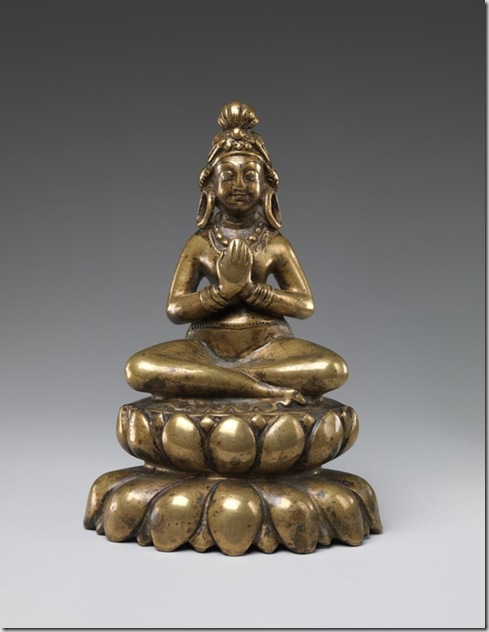 Tara Pakistan (Swat Valley region) 7th century
Abit later, we witness the emergence of deified females who have identifiable roles associated with the protection of children and with the life-affirming powers of water. The former finds expression in goddesses who originally may have been devourers of children—that is, the bearers of disease. Over time some were placated and thus acquired more benign aspects. The enthroned goddess with a cornucopia and children, from northwestern India, represents this tradition.
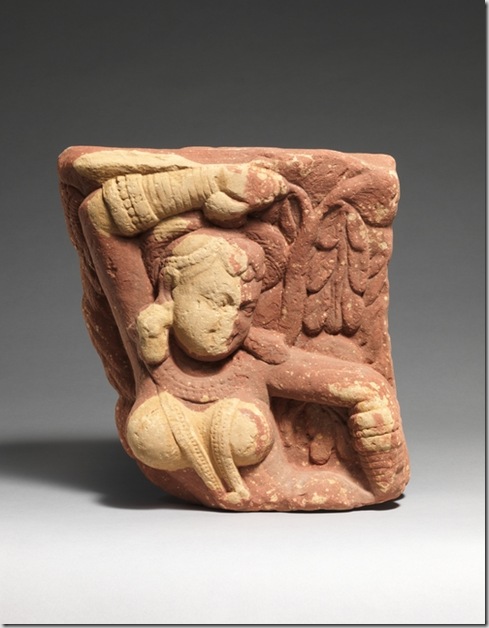 Tree Spirit Deity (Yakshi) India (Uttar Pradesh, Mathura region) 1st–2nd century
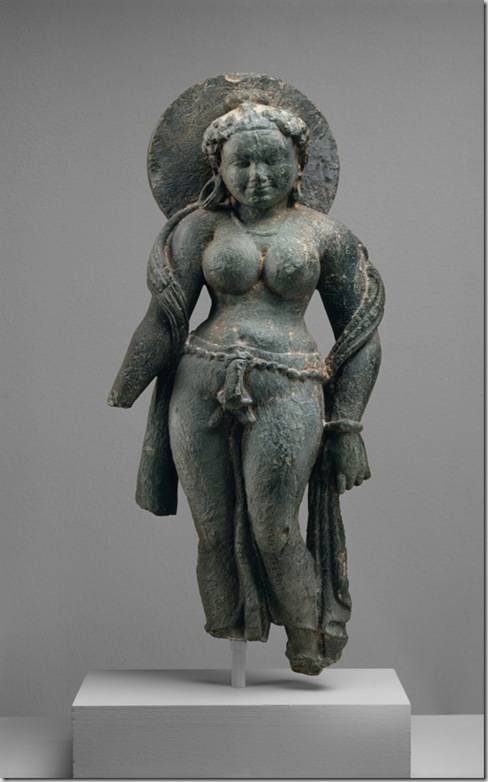
Mother Goddess (Matrika) India (Rajasthan, Tanesara) Post-Gupta period
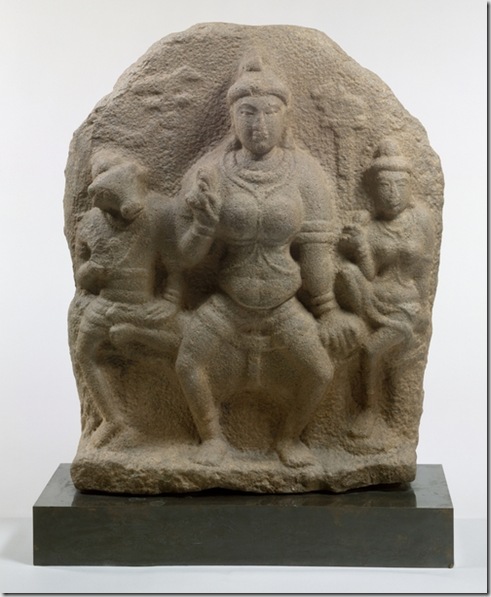
Jyeshtha Flanked by Her Children India (Tamil Nadu) Chola period 9th–10th century
A second association is with the creation of life. This female principle is expressed in a number of ways; as the bearer of life, we see the appearance of the cult of the
yakshi—personified female nature spirits—who embody the fecundity and fertility of nature. They survive in sculptures from the early centuries B.C. and were appropriated into Buddhist and Jain worship about the first century A.D.
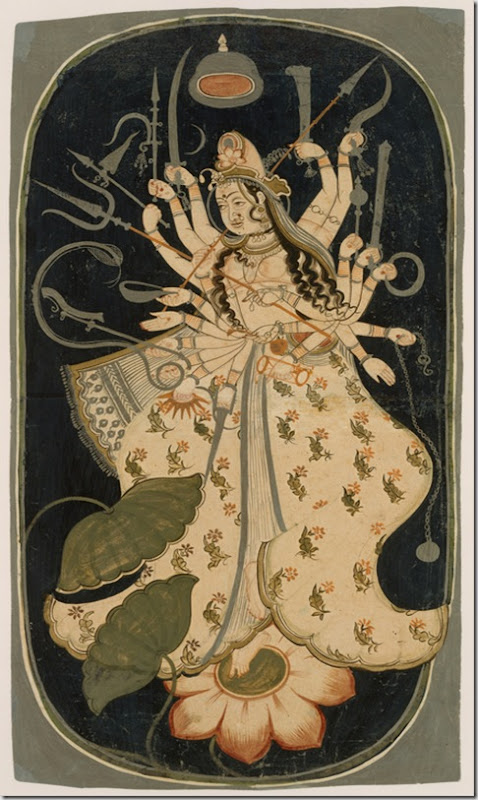
Mahadevi, the Great Goddess India (Rajasthan, Bikaner) ca. 1725
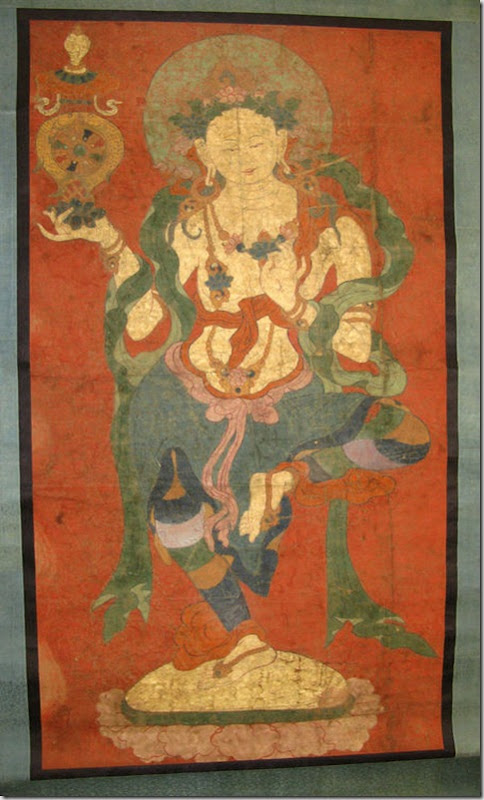
Buddhist Attendant, Possibly a Dakini Eastern Tibet late 18th century
The other powerful expression of the goddess as the source of life in early India is the personification of the great rivers of the subcontinent. Three rivers of northern India—the Ganges, the Yamuna, and the now-lost Saraswati—were worshiped as some of the most ancient deities of India. Sri Gaja-Lakshmi, the benign goddess being bathed by a pair of elephants—a metaphor for the life-giving powers of the monsoons—emerged to denote auspiciousness, prosperity, and good fortune. Saraswati, revered by Hindus, Jains, and Buddhists alike as the embodiment of wisdom and knowledge, is one of the earliest goddesses to have cult images made in her honor. The Jain mother goddess Ambika embodies the maternal principal.
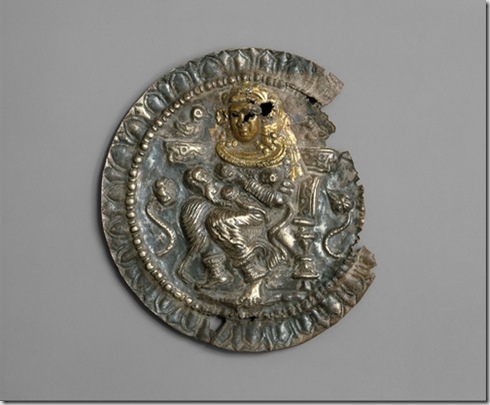
Rondel with the Goddess Hariti Pakistan (ancient region of Gandhara) ca. 1st century
About the sixth century a variety of early sources on
devi in her myriad forms were brought together in the seminal text the
Devi Mahatmya. Primarily devoted to narrating the origins of Durga and her relationship to the pantheon of male deities, the text represents Durga as the ultimate destroyer of demons. It also introduces the awesome forms that emerge from her being, Kali and Camumda, who give expression to Durga's terrible aspect, as do the seven
matrikas(mothers).

Vasudhara, Goddess of Wealth Nepal 14th–15th century
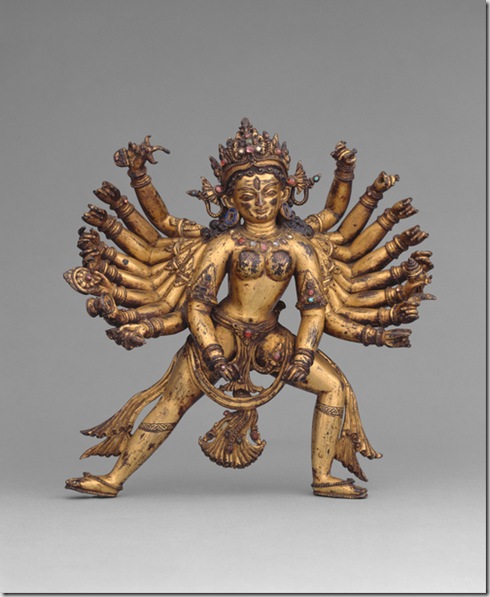
Durga as Slayer of the Buffalo Demon Mahisha (Mahishasura Mardini) Nepal 14th–15th century

The Goddess Durga Slaying the Buffalo Demon (Durga Mahishasura Mardini) India (Himachal Pradesh, probably Chamba) 12th century
The worship of the goddess continues to shape Hindu practice today, with Sri Lakshmi pouring down golden coins as its most popular expression.

The Goddess Durga Killing the Buffalo Demon, Mahisha (Mahishasura Mardini) India (Rajasthan, Mewar) ca. 1760
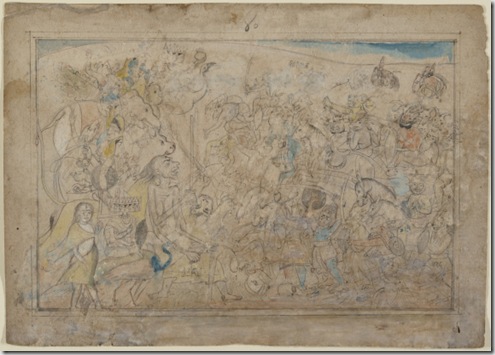
Durga, Kali, and Five Matrikas Battle the Daitya Army of the Demon Shumbha: Scene from the Devi Mahatmya India (Himachal Pradesh, Guler) ca. 1780
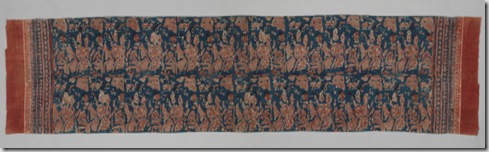
Ceremonial Textile Decorated with Female Courtesans with Attendants and Parrots India (Gujarat) late 14th–early 15th century
Fonte
![clip_image003[4]](http://lh3.ggpht.com/-vnSeL0Ucuyw/TqkoGDrhllI/AAAAAAAA7BQ/T6kKYqqbEgk/s1600-h/clip_image003%25255B4%25255D%25255B6%25255D.jpg "clip_image003[4]")
![clip_image004[4]](https://blogger.googleusercontent.com/img/b/R29vZ2xl/AVvXsEiZso9olnmZX2SB35WJpQ6RrmokpJLa_MVBvrb_HzW4dgl7q7Scy4fDg33vSuV8ChCADe_-W4XwnvfQmNZEIpGQetT4gjiig5KfTlxhK4vm2oYQEoQBLA329T_R23AUGIXDC7UkGzv6pUXK/s1600-h/clip_image004%25255B4%25255D%25255B9%25255D.jpg "clip_image004[4]")
![clip_image005[4]](http://lh6.ggpht.com/-L7I4ZYi_de4/TqkoLAZ4peI/AAAAAAAA7Bw/HjY2W0o7zuk/s1600-h/clip_image005%25255B4%25255D%25255B5%25255D.jpg "clip_image005[4]") Non-illustrated manuscript, folio, second half 9th–mid-10th century, Tunisia, probably Qairawan, Gold and silver on indigo-dyed parchment
Non-illustrated manuscript, folio, second half 9th–mid-10th century, Tunisia, probably Qairawan, Gold and silver on indigo-dyed parchment![clip_image006[4]](https://blogger.googleusercontent.com/img/b/R29vZ2xl/AVvXsEih6WuBfB2Zdx99rSnN-eyfspfEEJ2YzalsgAk93AxVCUP1WSbJPq6IXUKTqgHS883m0Y3QyqDkuMmNI2l4_HTpz1Ua4Cn26sjGvjnId7Fjzgiw9QdD6htOws4n3g665_fjwojsCEfbh7Ul/s1600-h/clip_image006%25255B4%25255D%25255B6%25255D.jpg "clip_image006[4]") Incense burner, dated A.H. 577/ A.D. 1181–82, Iran, Bronze; cast, engraved, chased, pierced
Incense burner, dated A.H. 577/ A.D. 1181–82, Iran, Bronze; cast, engraved, chased, pierced![clip_image007[4]](http://lh3.ggpht.com/-h_V1oBuq-4o/TqkoPlBzHRI/AAAAAAAA7CQ/mmoiT9HITLI/s1600-h/clip_image007%25255B4%25255D%25255B5%25255D.jpg "clip_image007[4]") Mosque lamp, ca. 1325, Egypt or Syria, Glass, colorless with brown tinge; blown, folded foot, applied wick holder and handles, enameled and gilded
Mosque lamp, ca. 1325, Egypt or Syria, Glass, colorless with brown tinge; blown, folded foot, applied wick holder and handles, enameled and gilded![clip_image008[4]](https://blogger.googleusercontent.com/img/b/R29vZ2xl/AVvXsEhgOGoq444o5gdeytArflS8BsbZNim_nYmbdtdIhdwTy78QKfgY8Bjz2EXb6UoCLnyP81jjpDrCuNyZYk6VRadoK8963K0sk3aeFAbY3TlVXWnr9PHAVbPjoYXSERTrpQ5KHdeqJSz98LmB/s1600-h/clip_image008%25255B4%25255D%25255B6%25255D.jpg "clip_image008[4]") Astrolabe, dated A.H. 690/ A.D. 1291, Yemen, Brass; cast and hammered, pierced, chased, inlaid with silver
Astrolabe, dated A.H. 690/ A.D. 1291, Yemen, Brass; cast and hammered, pierced, chased, inlaid with silver![clip_image009[4]](http://lh4.ggpht.com/-f1GXeKvypRc/TqkoTaS5-aI/AAAAAAAA7Cw/6ZROoFrxEKo/s1600-h/clip_image009%25255B4%25255D%25255B6%25255D.jpg "clip_image009[4]") Dish, 10th century, present-day Uzbekistan, Samarqand, Earthenware; white slip with polychrome slip decoration under transparent glaze
Dish, 10th century, present-day Uzbekistan, Samarqand, Earthenware; white slip with polychrome slip decoration under transparent glaze![clip_image010[4]](https://blogger.googleusercontent.com/img/b/R29vZ2xl/AVvXsEi15m6h4CIwCT4LeJjlV_He9C08JRe975a6MxS0cg2rsqPSDJGB-BtICE66LcFnrAuytx7wiNDyImKCBoDUokWCP6lJZBOPdw4KqFS2V5bi8lxkKSSHgkRBg7ntlWt_AXU4e6sCA7Ywt3b7/?imgmax=800 "clip_image010[4]") Tughra (Official Signature) of Sultan Suleiman the Magnificent (r. 1520–66), Turkey, Istanbul, Ink, opaque watercolor, and gold on paper
Tughra (Official Signature) of Sultan Suleiman the Magnificent (r. 1520–66), Turkey, Istanbul, Ink, opaque watercolor, and gold on paper![clip_image010[4]](https://blogger.googleusercontent.com/img/b/R29vZ2xl/AVvXsEikJ5m-64zTo_jGcdPp9xVcRb0qBLkI9RoyccQo8BWgKLoWcWtO3QLkqwTzQSxuyXbOGodqTm1UVBcEkAIZUfevz1LsadlPUfktl9q7-j2WvVHqscldX4GJHghgZtA64xFCKACKPPaal85g/s1600-h/clip_image010%25255B4%25255D%25255B8%25255D.jpg "clip_image010[4]")
![clip_image011[4]](https://blogger.googleusercontent.com/img/b/R29vZ2xl/AVvXsEhHK6cmd_wemhK9A6PK62_MyWZeVGjVqFB43wAK0GSObq-3z1HNe9t4-rD5s-MYuQXINBSbGR1sRINq0Ru27sf8Nzg7iHPP37g2b9Ts0vd-g7e30acLG-yqNxvYug7SoRbPGRcniS2K6-tE/?imgmax=800 "clip_image011[4]") Tile, frieze, late 13th century, Iran, probably Takht-i Sulaiman, Stonepaste; modeled, underglaze-painted in blue and turquoise, luster-painted on opaque white ground
Tile, frieze, late 13th century, Iran, probably Takht-i Sulaiman, Stonepaste; modeled, underglaze-painted in blue and turquoise, luster-painted on opaque white ground![clip_image011[4]](https://blogger.googleusercontent.com/img/b/R29vZ2xl/AVvXsEhZuwL_jZqa7gxXUV0VFp3w09pSpRrUm6OiITTlGwm7Gl6_T-2oQqXlJqYtm9vSFP6cVNi6_R54EeIUYbsYtCP8hCoZx2bLE0XEPHzASRlJqac_pgA2AmB0ltIoxKJlA0dBka38aWvYEKJW/s1600-h/clip_image011%25255B4%25255D%25255B9%25255D.jpg "clip_image011[4]")
![clip_image013[4]](http://lh3.ggpht.com/-1IwrStQ1-Q8/TqkoaEWtQfI/AAAAAAAA7Dg/xvZyxIIbXRc/s1600-h/clip_image013%25255B4%25255D%25255B5%25255D.jpg "clip_image013[4]") Carpet, second half 16th century, Iran, Silk (warp and weft), wool (pile); asymmetrically knotted pile
Carpet, second half 16th century, Iran, Silk (warp and weft), wool (pile); asymmetrically knotted pile![clip_image014[4]](https://blogger.googleusercontent.com/img/b/R29vZ2xl/AVvXsEi4VMuHvaOLnxnjGdu2ZzklIL07LWkMW1TAZ8Pse5ApgIsIdN2jEZw8s0WsoD6qQe-8TX-AAO5ZkT6s1P3_lLlfC3NegtAjeLGlZN8optDa88TkXvD0BFhHFyveAXH2bhyDV02cYhbgo9pI/s1600-h/clip_image014%25255B4%25255D%25255B5%25255D.jpg "clip_image014[4]") Panel, al-Hakam II (961–76), 10th–early 11th century, Spain, probably Cordoba, Ivory; carved, inlaid with stone with traces of pigment
Panel, al-Hakam II (961–76), 10th–early 11th century, Spain, probably Cordoba, Ivory; carved, inlaid with stone with traces of pigment![clip_image015[4]](https://blogger.googleusercontent.com/img/b/R29vZ2xl/AVvXsEg_sCj7l0iI2XLA1vsp5f8nsnQnJCCNbSVkR98o8lF0D3rTODIRa-LSqeO6kos8RAhnI1FkxsmpDqmaxjLa3jygTX9QwGenZuThYFUGgR23dbUUy7Vv5CuRJRnEAq22S7bCkZLVGjh9NsDC/s1600-h/clip_image015%25255B4%25255D%25255B6%25255D.jpg "clip_image015[4]") Flask, mid-17th century, India, Rock crystal; set with gold, enamel, rubies, and emeralds
Flask, mid-17th century, India, Rock crystal; set with gold, enamel, rubies, and emeralds![clip_image016[4]](http://lh3.ggpht.com/-RLLD0vU-8XA/Tqkog6J-N8I/AAAAAAAA7EQ/UrOT-sFepuw/s1600-h/clip_image016%25255B4%25255D%25255B8%25255D.jpg "clip_image016[4]")
![clip_image017[4]](https://blogger.googleusercontent.com/img/b/R29vZ2xl/AVvXsEhVD9jrYhk7B2aWx6BZU8xU1kTulBm77TCmI-8keU1Dx4H0qRdGcS7QhkHnQDdV7l2sJxPZwNK3ErGz43LEU5lP9yX7LJxRxw3cOmKXVCI_Uw2dZmUVxI-PV9LbiSgaZJnzZZGUjZTd5goY/s1600-h/clip_image017%25255B4%25255D%25255B9%25255D.jpg "clip_image017[4]")
![clip_image018[4]](https://blogger.googleusercontent.com/img/b/R29vZ2xl/AVvXsEgRqEX33IXwDo8bPplmRQmeEhg8cMYaiYF4OFUlwwHM4_UG8ziXhlW-_xrH99Jc-PsPIloB2tNka5fglepUczAuAjLkw0_xnz0roLdWmOlC4ZgcCfNo2CyXD6IBC5_QV8X_h0bT_xPFFBbH/s1600-h/clip_image018%25255B4%25255D%25255B9%25255D.jpg "clip_image018[4]")

![clip_image003[6]](http://lh3.ggpht.com/-NzjsMVHvPvM/TqkorFhFb9I/AAAAAAAA7FU/70ZruuZ8RkU/s1600-h/clip_image003%25255B6%25255D%25255B6%25255D.jpg "clip_image003[6]")
![clip_image005[6]](https://blogger.googleusercontent.com/img/b/R29vZ2xl/AVvXsEipG1IKM6hF5js5Ch1eLXTvxVHVsUu3EhyeBRNmQbjodSxgPTpj9mg8T_qqg9BKQJ172wdwLIPTXHgjT5hLjaiXmaruX1WN9o9UXZ4FxAzx74S4vDZfXgmy22TxLYcEBT3j_27IGRdZzoEd/s1600-h/clip_image005%25255B6%25255D%25255B5%25255D.jpg "clip_image005[6]")
![clip_image007[6]](https://blogger.googleusercontent.com/img/b/R29vZ2xl/AVvXsEj6Mtl46vATJfpfNKNgjVzm07DA4RJ6JHDmHPSahytNwa5qJgj-g2mDS_9MX3I7Qwgy_cl6pLlx8E4ykq6-IHmhbXTEEhvO_h4zdwsHodlBZdMcp-HXbgF52mtAG7DyV_SBStxyVFp8mor-/s1600-h/clip_image007%25255B6%25255D%25255B5%25255D.jpg "clip_image007[6]")
![clip_image009[6]](http://lh6.ggpht.com/-0MMUHuosCko/TqkoyWOrESI/AAAAAAAA7GE/f3gMyWxOZSM/s1600-h/clip_image009%25255B6%25255D%25255B5%25255D.jpg "clip_image009[6]")
![clip_image011[6]](https://blogger.googleusercontent.com/img/b/R29vZ2xl/AVvXsEgQjiocOJSwLs6D97ukxwP_aDMoFXms5RH2h9g_KAfpd1CkTdCq88oW1jaYpU2IBpaUyBZLmtIS-1b__zRQPwdwXm3yjGRxfM9J_9drmhPIPx7tGCErcZYU5BKyJ-oKRXXe_oC5fNACruvM/s1600-h/clip_image011%25255B6%25255D%25255B5%25255D.jpg "clip_image011[6]")


