
RAH AND MOTA LAVA are two small, remote islands that belong to the Banks Islands group of the South Pacific nation of Vanuatu. Their isolation from the rest of the world and the pristine, resource-abundant surrounding natural environment have led to the emergence of a unique culture and lifestyle.
The islanders rely primarily on subsistence living. Gardens, forests and the sea are the main sources of food. In order to eat, one has to be a skillful gardener, hunter or fisherman, the skills are picked up from a young age, through children watching and helping their parents.
Despite its remoteness and tiny size, Rah Island is famed for its exuberant snake-dance, inspired by the black and white colored sea-snakes, which reside under large rocks off of the island's shore. The performers travel as far as Port Vila, the capital of Vanuatu to demonstrate the dance at various cultural festivals.
heir isolation from the rest of the world and the pristine, resource-abundant surrounding natural environment have led to the emergence of a unique culture and lifestyle.
The islanders rely primarily on subsistence living. Gardens, forests and the sea are the main sources of food. In order to eat, one has to be a skillful gardener, hunter or fisherman, the skills are picked up from a young age, through children watching and helping their parents.
Despite its remoteness and tiny size, Rah Island is famed for its exuberant snake-dance, inspired by the black and white colored sea-snakes, which reside under large rocks off of the island's shore. The performers travel as far as Port Vila, the capital of Vanuatu to demonstrate the dance at various cultural festivals.

 The men of Rah Lava have fished with a bow and arrow in the crystal clear waters around the island for countless generations. Here a father takes his son out with him to demonstrate how the ‘fishing’ is done.
 Children playing in the lagoon. Every evening the island children swim and play in the lagoon.
 Snake dance performers getting ready. The snake dance is traditional to Rah and Mota Lava. Before only performed on special occasions, the dance is now one of the main ‘tourist attraction’ of the region.
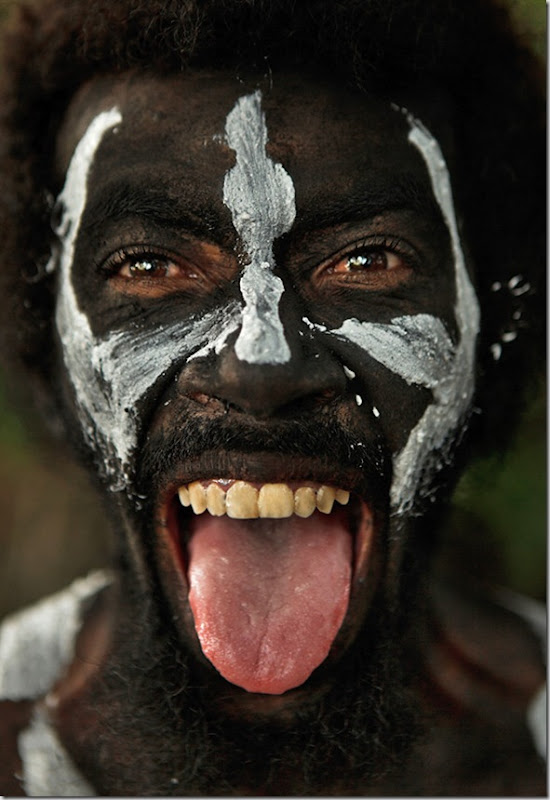 Before the performance the men get into their roles. They joke around, make faces and poke fun at each other.
 These days most of the performances take place on the beach outside of Rah Island, in front of the oldest running bungalow in the area.
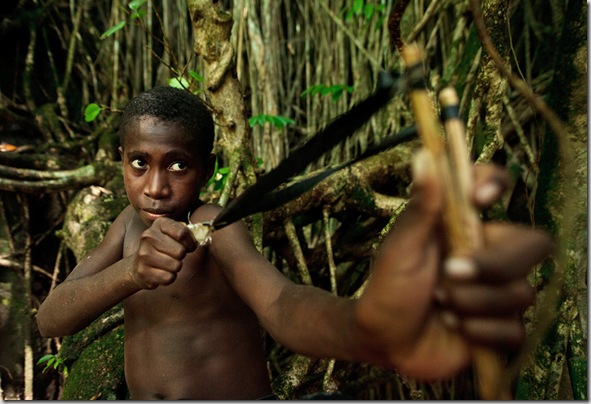 Teenage boy aiming at a bird with a sling-shot.
 Though a lot of the culture of Rah and Mota Lava was lost by the second half of the 20th century, certain aspects of the culture have been revived through a combination of the locals’ enthusiasm and foreign assistance.
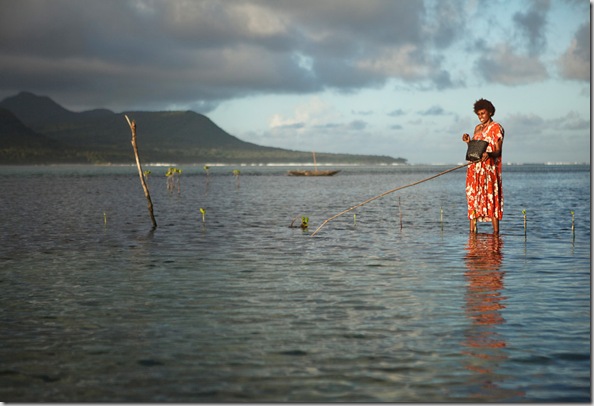 FIshing is done by nearly everyone on the islands.
 Girl and her dog return from the garden. The soil of the islands is one of the most fertile in the world. The islanders grow a wide range of fruits and vegetables, including - maniyuk, taro, yam, coconuts and bananas.
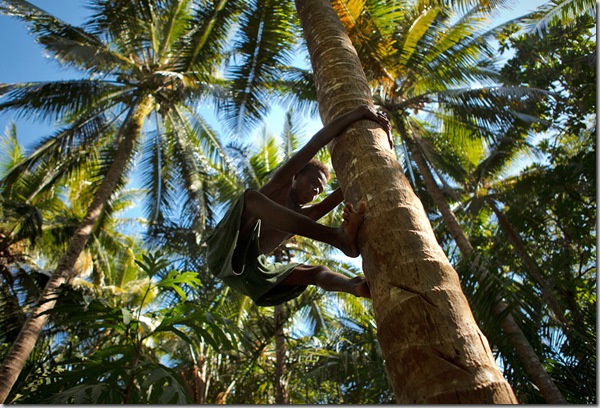 Harvesting coconuts is usually a job of the younger, male generation. Boys as young as eight are capable of climbing all the way to the top of the coconut tree.
 The Banks and Torres Islands group to which Rah and Mota Lava belong make up the only area in Vanuatu where the otherwise endangered coconut crab is in abundance. There are various techniques to capture the crustaceans, one includes the use of bait (a coconut) to lure them out from behind rocks, once the crab latches onto the coconut a skillful hunter grabs it and ties it up with a rope. A wrong move can easily result in the loss of a finger.
 As is the case with most villages in Vanuatu, mat-weaving is a big part of the women’s daily activities.
 The waters around the islands are rich in lobster. The men hunt the lobsters at a particular time during the evening, when the crustaceans come out of their underwater burrows to feed. Here the men are searching for the right spot to begin the hunt.
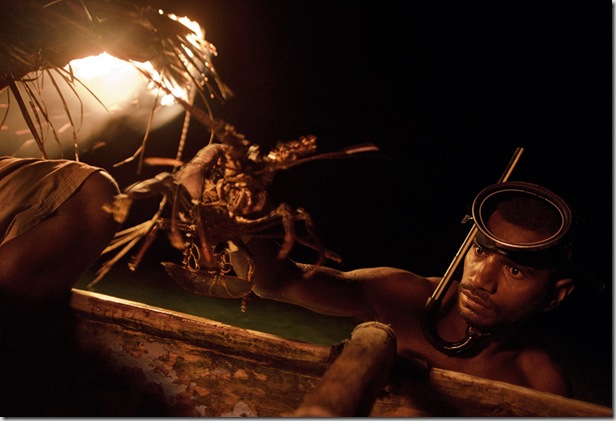 Man pulls out a lobster and puts it into the canoe.
Fonte
Man pulls out a lobster and puts it into the canoe.
Fonte
>>>
The islanders rely primarily on subsistence living. Gardens, forests and the sea are the main sources of food. In order to eat, one has to be a skillful gardener, hunter or fisherman, the skills are picked up from a young age, through children watching and helping their parents.
Despite its remoteness and tiny size, Rah Island is famed for its exuberant snake-dance, inspired by the black and white colored sea-snakes, which reside under large rocks off of the island's shore. The performers travel as far as Port Vila, the capital of Vanuatu to demonstrate the dance at various cultural festivals.
heir isolation from the rest of the world and the pristine, resource-abundant surrounding natural environment have led to the emergence of a unique culture and lifestyle.
The islanders rely primarily on subsistence living. Gardens, forests and the sea are the main sources of food. In order to eat, one has to be a skillful gardener, hunter or fisherman, the skills are picked up from a young age, through children watching and helping their parents.
Despite its remoteness and tiny size, Rah Island is famed for its exuberant snake-dance, inspired by the black and white colored sea-snakes, which reside under large rocks off of the island's shore. The performers travel as far as Port Vila, the capital of Vanuatu to demonstrate the dance at various cultural festivals.
all text and images © Mitchell Kanashkevich | Travel, traditions, culture - documentary, travel and cultural photography by Mitchell Kanashkevich

 The men of Rah Lava have fished with a bow and arrow in the crystal clear waters around the island for countless generations. Here a father takes his son out with him to demonstrate how the ‘fishing’ is done.
 Children playing in the lagoon. Every evening the island children swim and play in the lagoon.
 Snake dance performers getting ready. The snake dance is traditional to Rah and Mota Lava. Before only performed on special occasions, the dance is now one of the main ‘tourist attraction’ of the region.
 Before the performance the men get into their roles. They joke around, make faces and poke fun at each other.
 These days most of the performances take place on the beach outside of Rah Island, in front of the oldest running bungalow in the area.
 Teenage boy aiming at a bird with a sling-shot.
 Though a lot of the culture of Rah and Mota Lava was lost by the second half of the 20th century, certain aspects of the culture have been revived through a combination of the locals’ enthusiasm and foreign assistance.
 FIshing is done by nearly everyone on the islands.
  Girl and her dog return from the garden. The soil of the islands is one of the most fertile in the world. The islanders grow a wide range of fruits and vegetables, including - maniyuk, taro, yam, coconuts and bananas.
  Harvesting coconuts is usually a job of the younger, male generation. Boys as young as eight are capable of climbing all the way to the top of the coconut tree.
  The Banks and Torres Islands group to which Rah and Mota Lava belong make up the only area in Vanuatu where the otherwise endangered coconut crab is in abundance. There are various techniques to capture the crustaceans, one includes the use of bait (a coconut) to lure them out from behind rocks, once the crab latches onto the coconut a skillful hunter grabs it and ties it up with a rope. A wrong move can easily result in the loss of a finger.
  As is the case with most villages in Vanuatu, mat-weaving is a big part of the women’s daily activities.
  The waters around the islands are rich in lobster. The men hunt the lobsters at a particular time during the evening, when the crustaceans come out of their underwater burrows to feed. Here the men are searching for the right spot to begin the hunt.
 Man pulls out a lobster and puts it into the canoe.


